
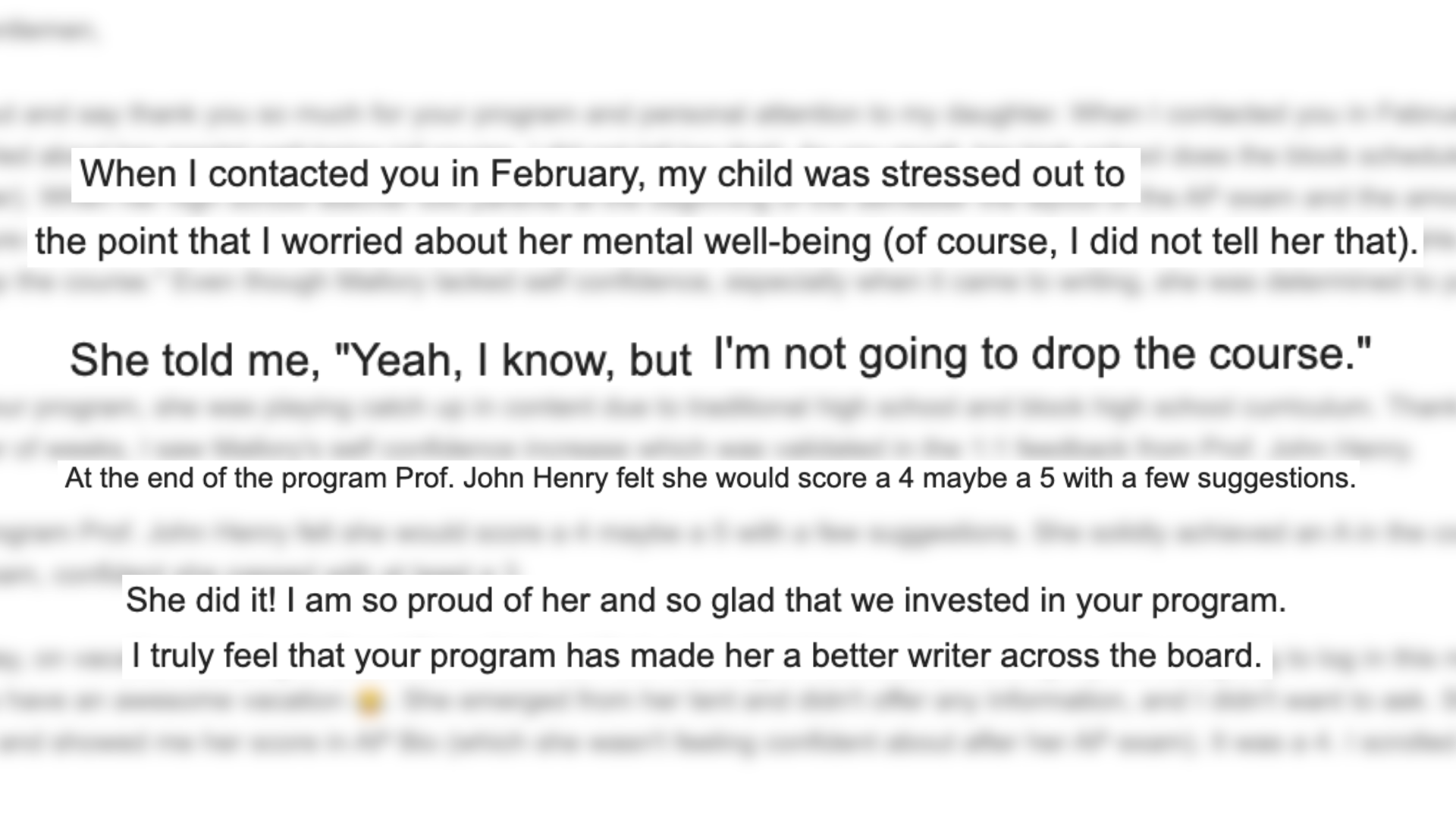
"I'm not going to drop the course."
How one AP student turned a stressful block schedule into a 4 and a 5, and became a better writer in the process
Mallory D. is a good writer. Everyone around her knew it, including her.
That wasn't the problem.
Her school runs on a block schedule, which meant a full year of AP European History had to happen in a single semester. When her teacher explained the volume of timed writing the exam would require, Mallory's mom asked her a fair question: are you sure you want to stay in this class?
Mallory didn't hesitate. "Yeah, I know," she said, "but I'm not going to drop the course."
That's the part of this story most AP prep programs skip past. Everyone wants to talk about the score. Almost nobody talks about the moment before it, when a student who is genuinely talented is still scared enough that quitting looks reasonable.
The real problem wasn't ability. It was pace.
Because of the compressed block schedule, Mallory started the program already behind on content. She could write. She just hadn't had the reps to write fast, under pressure, on command, the way the AP exam demands.
This is where our four-phase framework does its quietest work. Before a student writes a single practice essay under timed conditions, we diagnose exactly where the gap is: content knowledge, writing mechanics, or timing. For Mallory, it wasn't that she needed to learn to write. She needed to learn to write on the clock, using the specific structures AP readers are trained to score.
Working with Prof. John Henry, that's exactly what happened. Within weeks, her mother noticed something Mallory hadn't said out loud, a visible shift in confidence, later validated directly in 1:1 feedback: this was a student who was starting to trust her own writing again.
By the end of the program, John Henry's read was a 4, maybe a 5, "with a few suggestions."
Mallory finished the course with an A. She walked out of the actual AP exam confident she'd cleared a 3. That's what most students carry into results day: a guess, hedged low, because nobody wants to hope too hard.
Score day landed in the middle of a family camping trip to Grand Teton National Park. Her mom didn't sleep the night before. Mallory checked her results alone in her tent, then came out and showed her.
AP Biology: 4. AP European History: 5.
"I truly feel that your program has made her a better writer across the board."
That's the actual product here. Not a score. A skill that travels with her into every class, every application essay, every paper she'll ever write under a deadline.
Mallory came back the following year for AP Environmental Science. That's usually how we know a program is doing right by a family: not the first win, but whether they come back for the second one.
Ready to see what a real diagnostic and a four-phase plan could do for your student? Book a free call with us.